
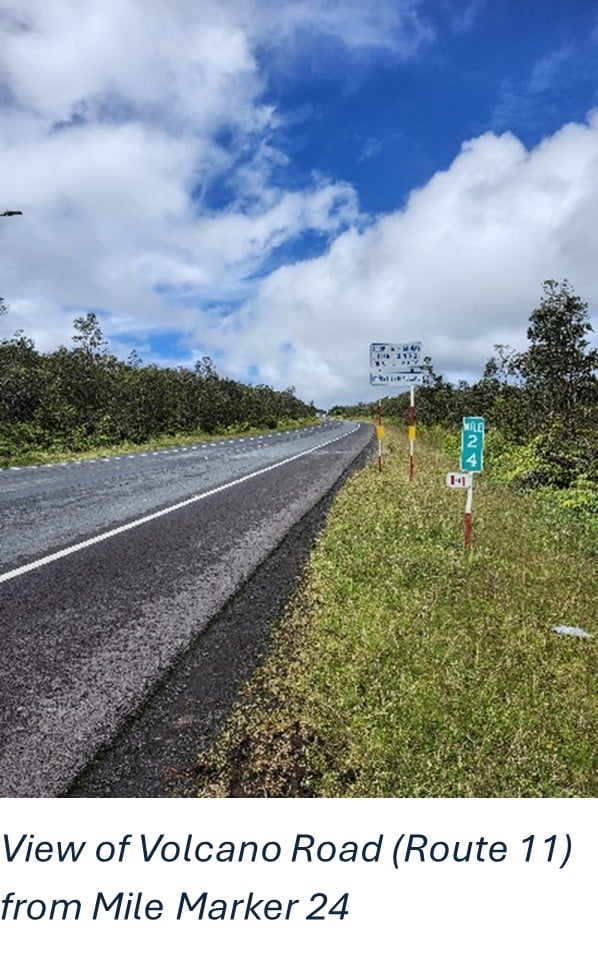

It took me a while to reach milepost 24 after leaving Hilo Airport – a drive that reminded me why they call it the Big Island. But the trip gave me a much better appreciation for the road I had come to see. Although Route 11 leads to Volcanoes National Park, it isn’t simply a scenic byway for visitors. It is an important artery connecting communities and destinations across the south side of Hawaii Island, and its history shows just how long an asphalt pavement can last with proper construction and periodic preservation.
The original road dates back to approximately 1926, but the asphalt pavement structure recognized by the award traces to a 1973 reconstruction. The 1973 reconstruction used 2.5 inches of State Mix V over 4 inches of asphalt treated base, 6 inch aggregate subbase and 18 inches of select borrow. In 1993, a 1.5 inch overlay of State Mix IV was added, and in 2013, a mill-and-fill overlay of 0 to 1.5 inches was completed. In total, only about 1½ to 3 inches of pavement thickness have been added during the past 35 years.
Today, this section of Hawaii’s Belt Road is a two-lane rural highway carrying about 2,200 vehicles per day. It winds through the extraordinary volcanic landscape surrounding the summit of Kīlauea volcano (Uēkahuna), and leads to places such as the lava tubes of Nāhuku and the steam vents near Crater Rim Drive. Along the way, the scenery shifts from native forest to volcanic craters and lava fields.
Of course, simply being old doesn’t make a pavement perpetual. The Asphalt Pavement Alliance’s Perpetual Pavement Award: By Performance recognizes asphalt pavements that have been in service for at least 35 years while maintaining their structural integrity. To qualify, resurfacing intervals must average at least 13 years, and rehabilitation during the previous 35 years cannot have increased the pavement’s total thickness by more than four inches. Engineers at the National Center for Asphalt Technology (NCAT) evaluate the nominations.
That is the basic idea behind a Perpetual Pavement. Rather than waiting for a pavement to deteriorate to the point that the entire structure must be reconstructed, a properly designed and maintained pavement can periodically have its surface renewed while the underlying structure remains in service. The investment already made below the surface isn’t thrown away every time the roadway needs attention.
The State of Hawaiʻi has an ongoing history with the Perpetual Pavement Awards. In 2023, Route 550, Kōkeʻe Road on Kaua’i received Hawaiʻi’s first By Performance award. The following year, Route 37 on Maui received the state’s second. Route 11 now makes three.
On September 18, John Romanowski of HAPI member Jas. W. Glover, Ltd. joined me in presenting the award to Cliff Corpuz and Francis Perez of HDOT’s Hawaiʻi District. Glover’s connection to the award is particularly fitting, since the company paved this section of Route 11. The recognition also reflects work done behind the scenes. HDOT’s “Pavement Guy,” Kyle Suzuki, prepared and submitted the application documenting the pavement’s construction and maintenance history.
Back in 2017, when HAPI first featured Perpetual Pavements in our newsletter, an award-winning Hawaiʻi road was still just a hope. “Perhaps one day, Hawaii will have an award-winning road,” Jon Young wrote. Nine years later, Hawaiʻi has three. And the awards aren’t limited to state highways—municipal roads are eligible, too. Perhaps one day, one of Hawaiʻi’s counties will have an award-winning road of its own.