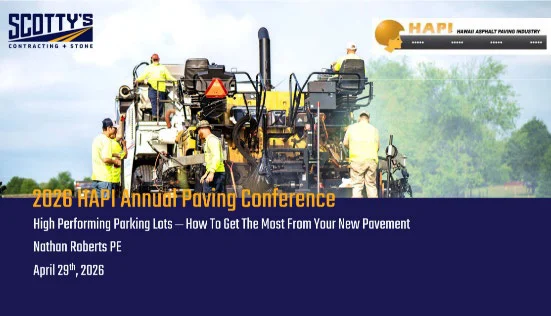
On April 29, HAPI’s 5th Annual LTAP/HAPI Paving Conference brought together a diverse audience for four engaging technical sessions followed by a lively game show-style review. Each presentation combined practical field knowledge with current research, reinforcing one central theme: better pavements come from research-based decisions, not outdated assumptions.
Session 1
Prime Coats versus Tack Coats
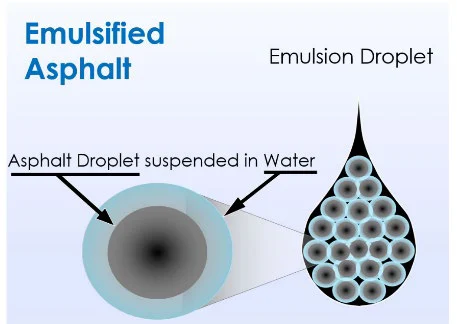
Session One tackled one of asphalt paving’s most deceptively simple questions: are tack coats and prime coats basically the same thing? Spoiler alert—they are not. While the materials may be similar, they are unique in purpose, timing, and application. Prime coat is applied to the base before the first asphalt lift to stabilize fines, weatherproof the surface, and support construction traffic. Tack coat, meanwhile, is the “bonding agent” or “glue,” sprayed between asphalt layers (or over existing pavement) to ensure old and new surfaces act as one cohesive pavement structure, reducing slippage, delamination, and cracking.
Since Hawaii agencies usually specify asphalt emulsion use for tack coats and prime coats, when needed, the presentation walked through asphalt emulsion basics. Topics included break-and-set timing and why proper application rate varies depending on whether the surface is new asphalt, milled pavement, or concrete. The session also highlighted how industry practices have evolved, especially in Hawaii. Prime coats, once considered essential, are now often reduced or eliminated on most projects because thicker pavement sections often perform well without them. Tack coats, however, remain non-negotiable for quality pavement performance.
Session 2
HP (High Performing) Binders: Past, Present and Future

Session Two took attendees deep into the world of modified asphalt binders—state-of-the-art engineered materials for asphalt pavements. The session explained that simply adding “some polymer” is not enough to provide optimal pavement performance: binder source, polymer type, and polymer percentage all matter.
Things got especially interesting when the session moved from conventional polymer-modified asphalt (PMA) into High Performance (HP) binders, where polymer loading more than doubles compared to standard PMA. These binders were portrayed as the heavy lifters of modern paving—designed for airports, intersections, ports, bridge decks, thin overlays, and other punishment-prone applications where mixes made with conventional PMA may be insufficient. Case studies showed HP binders delivering superior rutting resistance, delayed cracking, reduced structural thickness, and even long-term sustainability gains through extended pavement life.
The catch? HP binders demand discipline: tighter temperature control, careful storage, continuous production, and excellent construction practices. High-performing binders are not just “more expensive asphalt”—they’re strategic infrastructure investments, offering Hawaii an opportunity to think beyond upfront cost and toward longer-lasting pavements.
Session 3
MixBusters: The Truth About Asphalt Myths
Drawing from the Asphalt Institute’s “MixBusters” series, this session took aim at some of paving’s most stubborn myths and dismantled them with research, field evidence, and just enough humor to keep even seasoned attendees leaning forward. Whether discussing lift thickness, tack coat use, aggregate size, roller types, or specification complexity, the message was refreshingly consistent: science beats myth every time.
Science beats myth every time.
The first myth busted was the belief that thicker asphalt lifts compact poorly. In reality, research shows almost the opposite: increasing lift thickness generally improves densification, as long as paving equipment and practices are adequate for the task.
Another myth casualty was the idea that tack coat can be skipped between lifts laid within hours of each other. NCAT studies, fatigue-life charts, and dramatic bonded-vs-unbonded demonstrations showed that even minor bond loss can devastate pavement life, with some studies citing 50–75% life reductions.
The pneumatic roller segment tackled one of construction’s most practical debates: are rubber-tired rollers worth the hassle? The answer was a strong yes—with caveats. The “problems,” such as asphalt sticking to tires and maintenance headaches, were presented less as fatal flaws and more as manageable operational details that can be addressed by preheated tires, skirts, release agents, and coco mats. Research from NCAT, TTI, and Washington DOT shows they consistently improve compaction uniformity, reduce thermal segregation density differences, increase joint density, and create tighter surface texture.
The session also pushed back on the role of large stones and overly complicated pavement specifications. Bigger aggregate does not automatically equal stronger pavement: density, binder properties, balanced mix design, and constructability matter more. Likewise, increasingly complex specifications do not guarantee better pavements. Research repeatedly shows that simpler, targeted, outcome-based specifications outperform cumbersome rules.
Session 4
High Performing Parking Lots: How to Get the Most from Your New Pavement
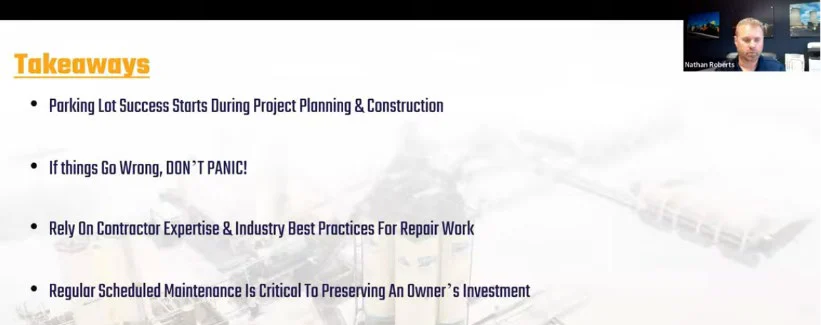
Session Four was a practical, field-tested masterclass that illustrated that high-performing parking lots rely on planning and communication to prevent expensive rework. The key takeaway was that parking lot success starts long before construction and continues long after the rollers leave. It reinforced that while smoothness, thickness, compaction, and slope control are the fundamentals that make a lot quietly perform for years, parking lot life is often determined as much by maintenance as by construction quality. High-performing parking lots require crack sealing, seal coating, restriping, and proactive upkeep to preserve durability and aesthetics. Recommendations included sealing new asphalt within two years and restriping every 4–6 years to stay ahead of wear.